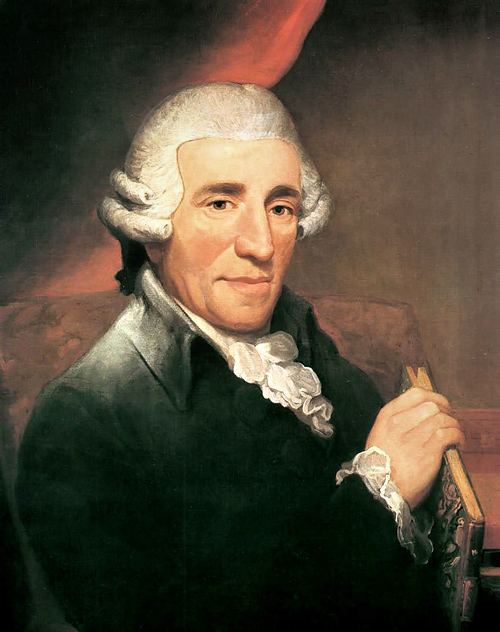
Joseph Haydn, 1732-1809, a member of the First Viennese School, helped perfect the instrumental language of the Classical era and was the last eminent composer to work primarily under the royal patronage system.
After achieving moderate success in Vienna as a composer, Haydn was recruited by Prince Paul Anton Esterházy, the head of the wealthiest and most influential family in Hungary. Haydn served as Kapellmeister for the Esterházy family for thirty years. His duties included composing, conducting, performing, and teaching. The Minuet in F Major, the subject of this lesson, was composed for the daily chamber music sessions held in the Prince’s apartment. Notably, the Prince himself participated as the bass player (the ukulele 3 part).
Esterházy Palace | The royal court where Haydn worked | Wikimedia Commons
Minuet Musings
Our ensemble is a minuet, a stately ballroom dance in triple meter. The minuet originated in France and was popular during the seventeenth and eighteenth centuries, particularly among the aristocratic class. It was often featured in Baroque dance suites and Classical symphonies.
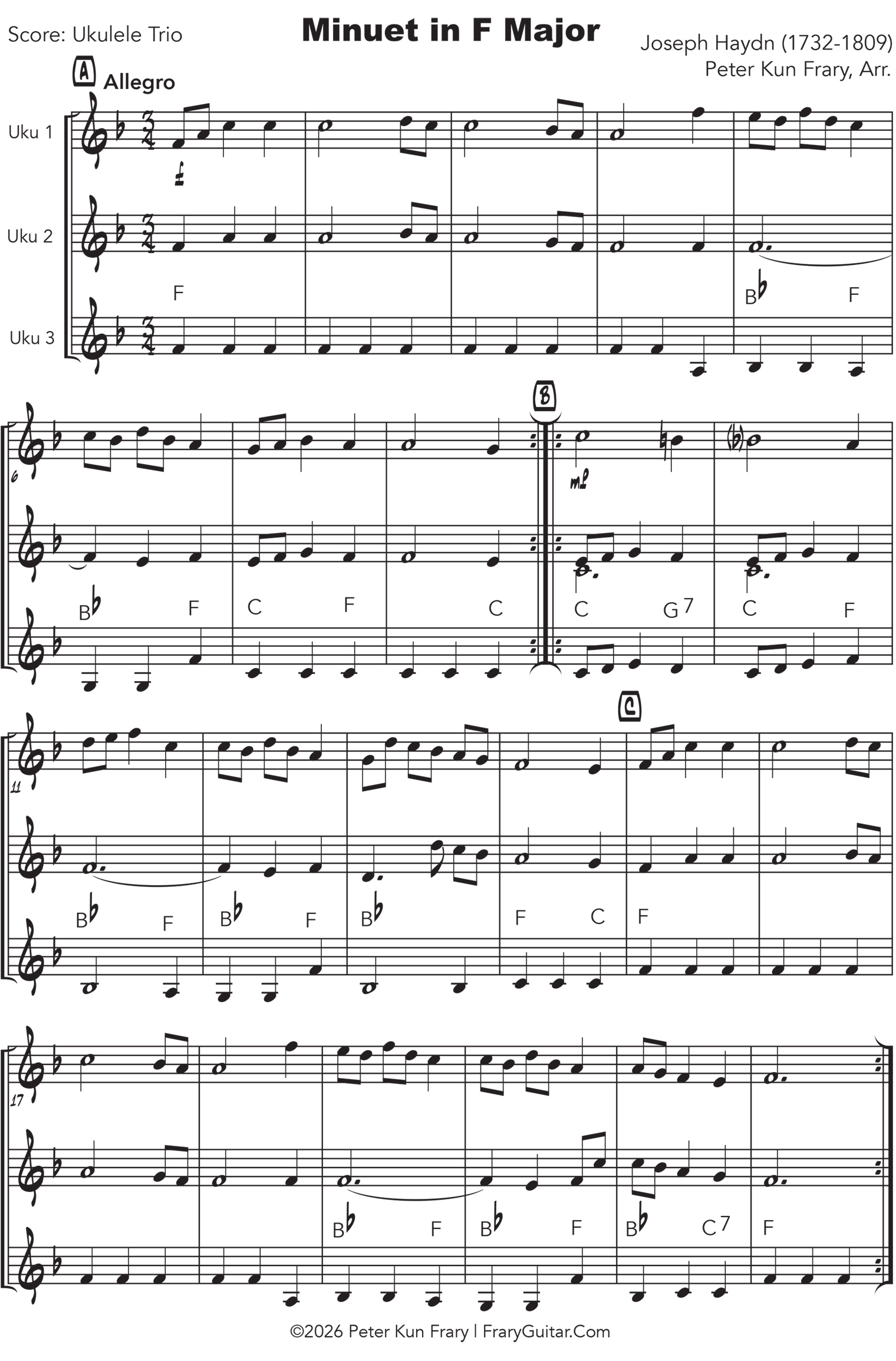
Minuet is a trio and thus has separate parts: ʻukulele 1, ʻukulele 2, and ʻukulele 3. The main melodic duties lie with ʻukulele 1, with ʻukulele 2 and ʻukulele 3 filling out the harmony and bass. Like Sanoe, Minuet uses 5th position notes in the ʻukulele 1 part. If needed, review the 5th position tutorial for Sanoe.
Haydn's Minuet in F Major | Leeward CC ʻukulele students.
Bring out the downbeat so the triple meter pulses predictively. After all, it is a dance. Aim for a gentle allegro of about 120 BPM.
The individual parts, with notes and TAB, may be be downloaded from links at the bottom of this page.
 •••
•••
 Joseph Haydn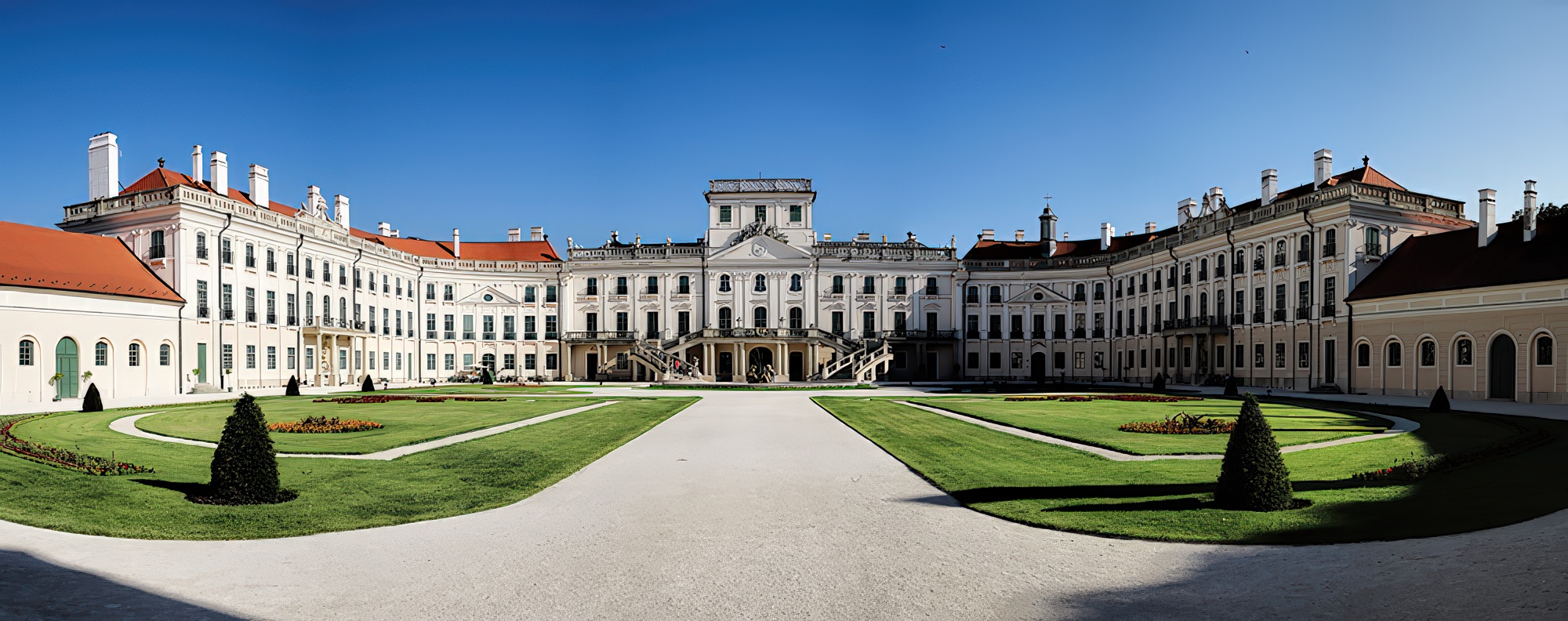
 Minuet Musings
 Haydn's Minuet