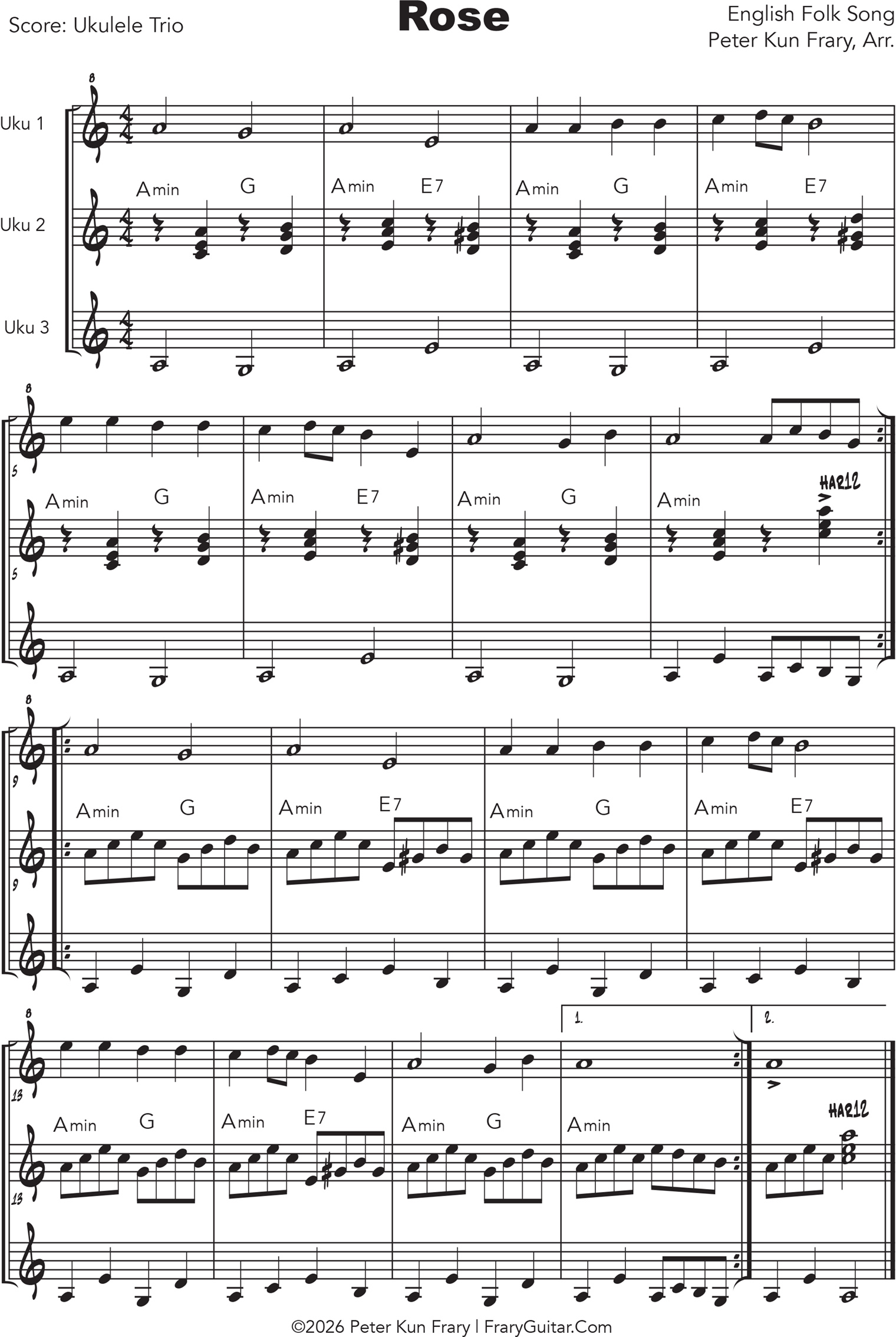
In this chapter, you'll take on a five-hundred year old English folk song, Rose.
Floral Musings
Roses have a long legacy as a song subject: The Yellow Rose of Texas, The Rose, The Last Rose of Summer,etc. Our piece today, Rose, is yet another song about this thorny flower. Roses are frequently a metaphor for your heart or object of desire, and not so much about the prickly bloom.
Our Rose is an English folk song about a flower blooming or, more accurately, delaying bloom. Rose exists in many versions—change is in the nature of a folk song—and both the lyrics and melody have been fluid throughout its history.
The Elizabethan English of the lyrics date Rose to the late Renaissance, the time of Shakespeare and the King James Bible. Here's the first verse:
Rose, rose, rose, rose,
Shall I ever see thee red?
Aye, indeed, that thou wilt,
If thou but stay
Later versions replace "red" with "wed" and thus steer the lyrics towards marriage!
Study Tips
Melody
Rose is arranged as a trio: ʻukulele 1 plays the melody, ʻukulele 2 strums and arpeggiates the chords, and ʻukulele 3 plays a quasi bassline. Like Sanoe, Rose uses 5th position notes on the first string. Here's a reminder if you forgot the new notes:
Fifth Position | Notes on the first string
Rose's two phrase melody is determined and straight to the beat. At a faster clip, I dare say the melody is swashbuckling. Imagine swinging your ale to the metric accents. Aim for a slow allegro of about 120 BPM.
Chords
Rose's chord transitions are relatively easy so it's all about making them sound smooth, sonorous and beautiful.
ʻUkulele 2 Strum
The Reggae strum, studied in Sinner Man, is also used on Rose's ʻukulele 2 part.
Strum downwards on beats 2 and 4.
Mute beats 1 and 3.
Harmonics
ʻUkulele 2 uses natural harmonics (Har12) in measures 8 and 17. Lightly touch, but don't press down, the first, second, and third strings directly above the twelfth fret while strumming or plucking the strings. Once executed, immediately remove the left-hand finger off the strings so the bell-like tone of the harmonics ring freely.
Practice
Finally, get the sound of Rose in your ears by listening to the audio track. Once you've worked out the mechanics of the piece, practice with the audio track.
The individual parts, with notes and TAB, may be be downloaded from links at the bottom of this page.
 •••
•••

 Floral Musings
 Study Tips
 Melody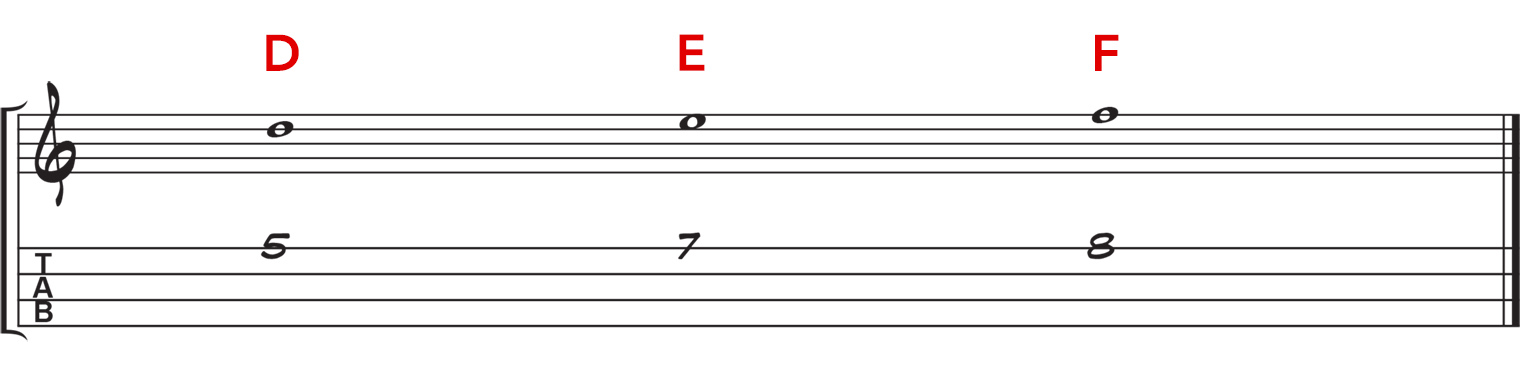

 ʻUkulele 2 Strum
 Practice
 Rose
Rose