 ••• •••
|
||||||||||||||||||
.
|
 ʻUkulele Anatomy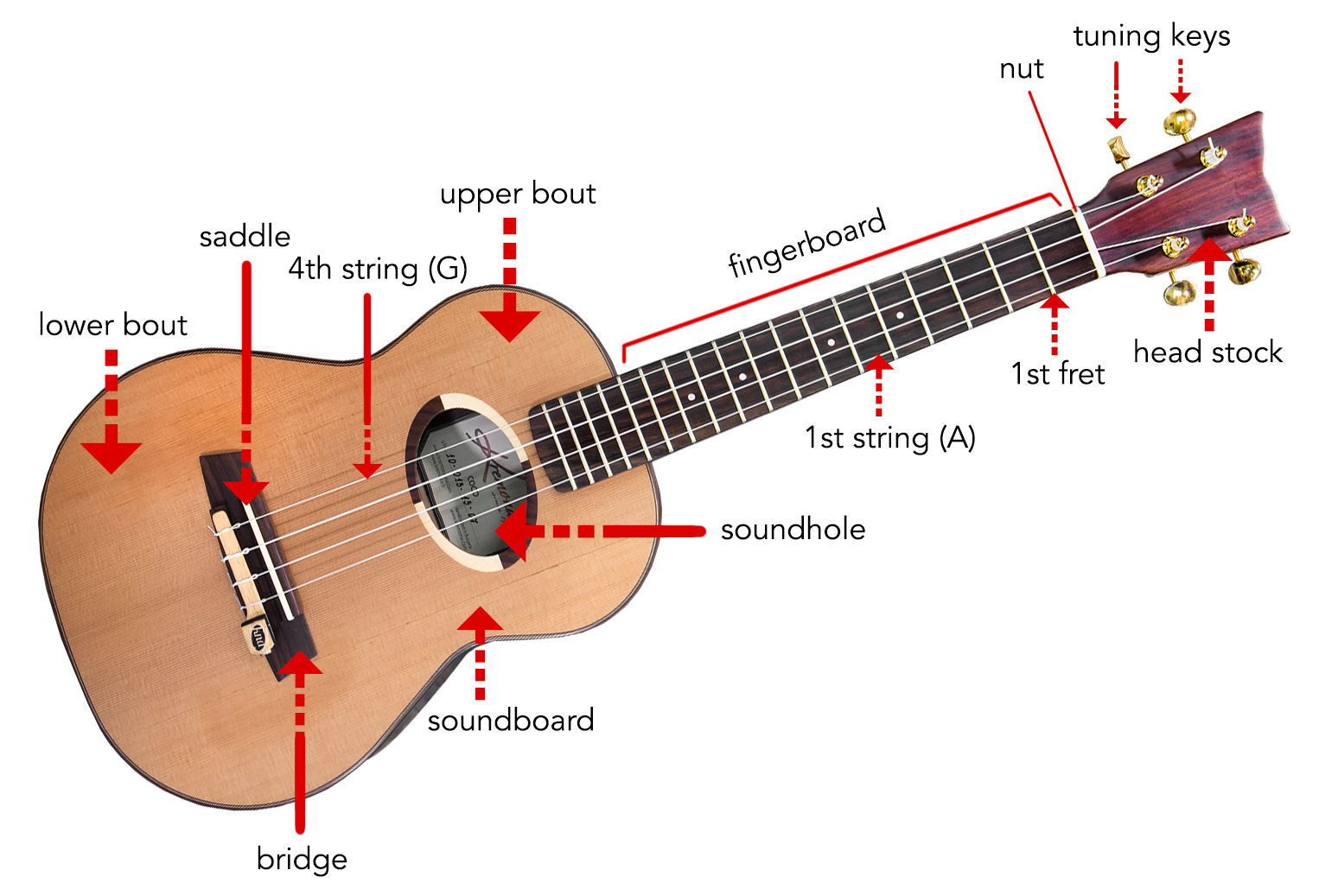
 Human Anatomy
FingeringsRight-hand and left-hand finger names and their abbreviations are used in this textbook to indicate fingerings in notation and technical discussions. For example, the F chord depicted on the right is labeled with left-hand fingerings above the diagram. |
 |
Left-Hand Fingernails
Trim your left-hand fingernails as short as possible—below the fingertips. Why? Short nails reduce buzzing and muffled tones by allowing a solid contact between finger and string.
Right-Hand Fingernails
The nails of the right-hand may be used to pluck and strum the strings. Grow fingernails about 1/16 of an inch beyond the fingertips. The right-hand thumbnail should protrude about 1/8 of an inch beyond the tip.
Use an etched glass file or a powdered gemstone finishing file to shape the nail into a half-circle. Glass and gemstone finishing files are available at Amazon and in the beauty departments of Longs Drugs, CVS and Walgreens.

After shaping the nail, finish its edge and underside, the contact surfaces, with a nail buffer such as the Tropical Shine 3-Way Buffer or 1000 grit or finer sandpaper. Lightly sand your nails daily: rough nails make a harsh tone and are more prone to snagging than smooth nails.
Fingers 'n Fingernail Care | I made this video for guitarists, but fingernail care and maintenance are identical for ʻukulele players.
Poor Nails or No Nails?
If you can’t grow adequate nails, use the fingertip flesh to pluck the string. The flesh yields a beautiful timbre, but more mellow sounding than nail tone.
 String Names
The four strings of the ʻukulele have both a letter and number name. The highest pitched string, the one nearest to the floor while in playing position, is the first string or A string. The string nearest to your face, is the fourth string or G string. Memorize both the letter and number names of the strings.
String Diagram | Vertical lines are strings and horizontal lines represent frets.

Goats Can Eat Anything
If you need help remembering the strings, try this mnemonic device: Goats Can Eat Anything. The first letter of each word spells out the string names. Chant it over and over until it sticks in your brain.
Re-entrant and Low G Tuning
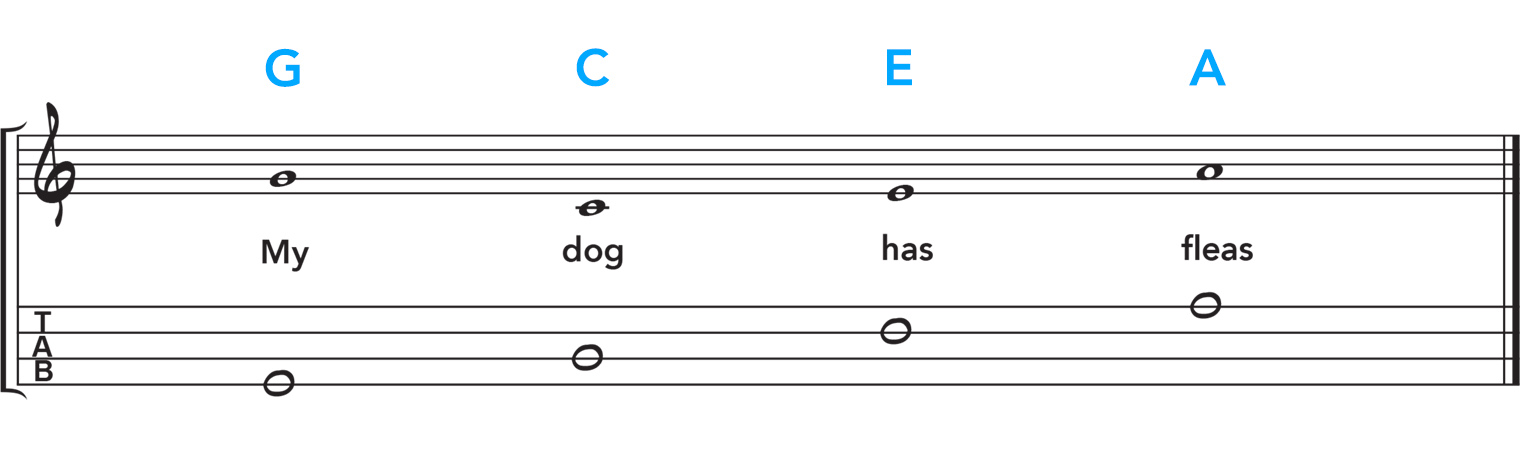
The 'ukulele uses two variations on the G C E A tuning: re-entrant and low G. Low G tuning uses strings arranged in order of pitch, similar to a guitar or violin. Re-entrant tuning pitches the fourth string an octave higher than low G—the other strings are identical—resulting in the famous "My dog has fleas" motive on the open strings.
Re-entrant Tuning | Used on soprano, concert and tenor ʻukulele. Also known as high G tuning.
Low G Tuning | Used by some players on tenor ʻukulele. Also called linear or bourdon tuning.
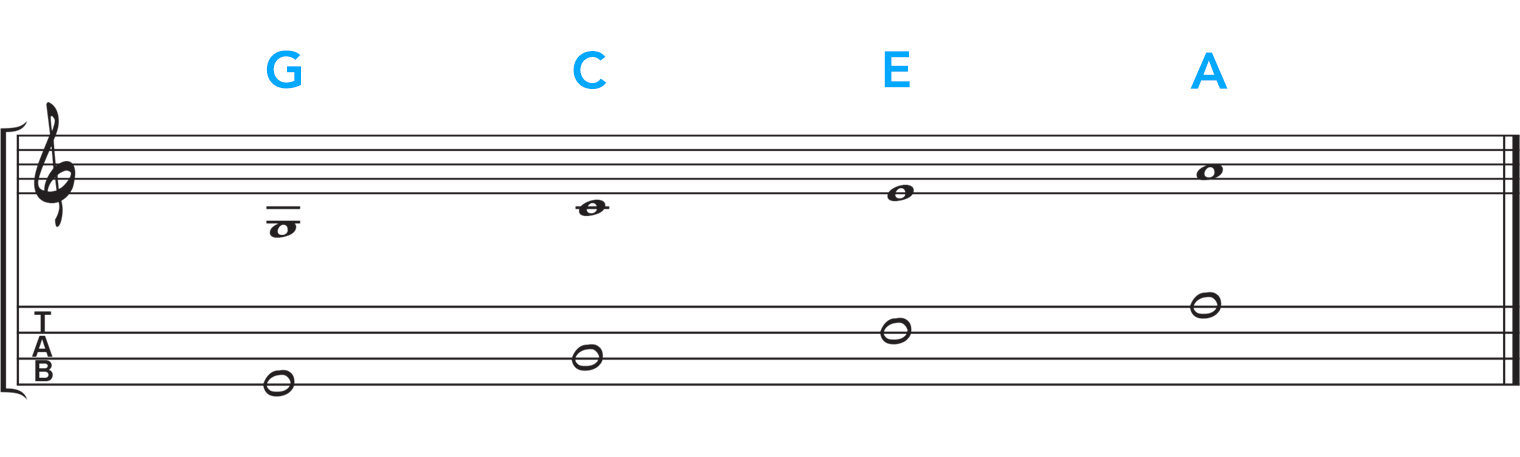
Both low G and re-entrant tuning are welcome in this course. Fingerings and names of chords are identical. What's the difference in sound? For strumming, re-entrant tuning is brighter and more chimey whereas low G is deeper and more bass rich. For playing single line melodies on the other three strings, C, E and A, both tunings are identical.
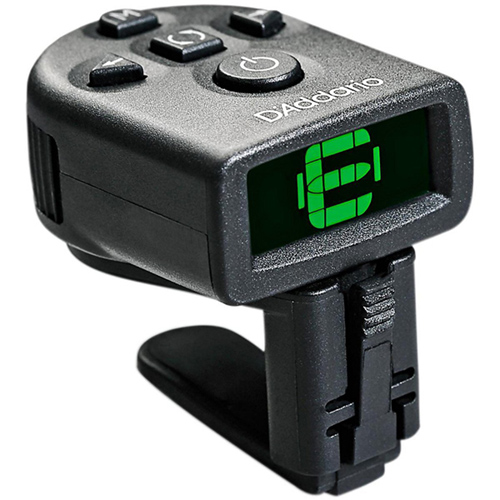
D'Addario NS Micro Tuner | Photo courtesy D'Addario
 Tuning
ʻUkuleles need to be tuned daily, albeit normally small adjustments. The easiest way to tune is to use an electronic tuner. Tuners display the pitch name and if the pitch is flat, sharp or in tune.
A clip-on tuner such as a D'Addario NS Micro Clip-On Tuner is recommended. The D'Addario NS Micro is inconspicuous and may be installed long-term without harm to the instrument.
D'Addario NS Micro | Installed on headstock

The NS Micro senses pitch through wood vibration rather than airborne sound. The advantage of vibration sensing is tuning is reliable in noisy environments such as classrooms and backstage.
Tuning Apps
A smartphone tuning app may be used to tune your ʻukulele. I recommend D'Addario D'Tools, available free at the Apple App Store and Google Play. This app has setups for different instruments, but I recommend the chromatic mode.
D'Addario D'Tools App | The meter indicates the note E is a little flat. To tune, tighten the tuning key so the meter centers at 0.

There are many good tuner apps—GuitarTuna comes to mind—but most of them require a subscription to disable the persistent and infuriating ads.
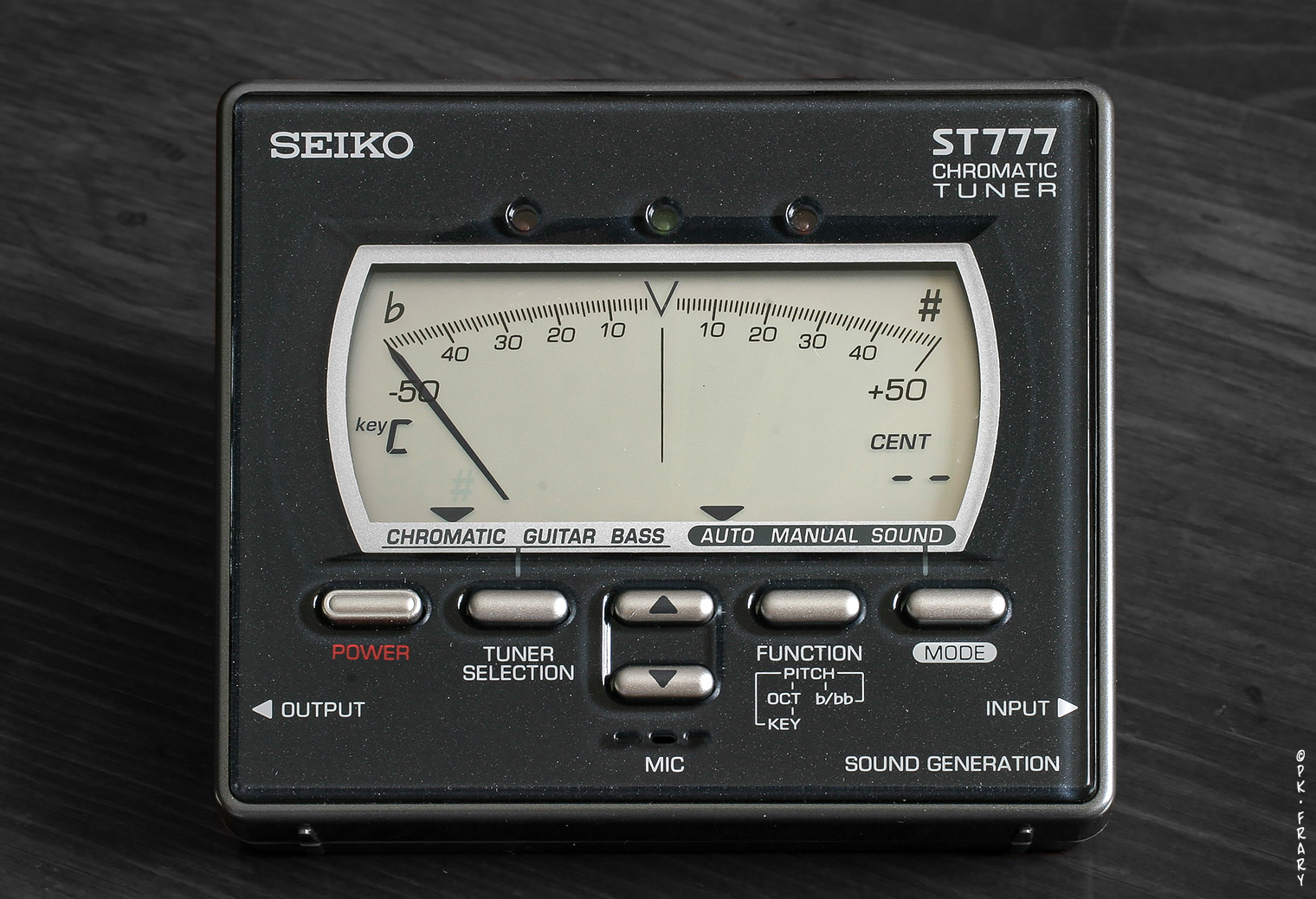
Seiko ST777 Tuner | Old school brick tuners often have extras like tone generation and cable pass-through for use with pickups and pedal-boards.
Ready to Tune!
Before using a tuner, memorize the letter names of the strings (see "string names" above). Otherwise, the LCD readout will not make sense. Tuners are not smart devices; that is, they don't know how your instrument should be tuned. They simply measure existing tuning. You take this information and decide how to tune it. Here's how to tune your first string:
- Power on the tuner.
- Gently pluck the first string (A) every couple seconds.
- Observe the displayed pitch.
- Is it too high or too low?
- Using the tuning key, adjust pitch as appropriate.
The crucial part for beginners is step 4: accessing the metered pitch. For example, if G or G# is indicated, tune the string higher until A is displayed. If B is shown, lower the string until A is indicated. Once the correct letter name is displayed, fine tune until perfectly dialed in.
How to tune your ʻukulele using a tuner
Tuning with an electronic tuner
Tuning Tips
- Tune with the front of the ʻukulele facing away from your body. Thus, if a string breaks, you won't be struck in the face.
- Turn the tuning key away from you to raise pitch and towards you to lower pitch.
- Tune up to the desired pitch rather than down to it. This reduces slippage by allowing the gears to lock.
- If you are not sure which way to adjust the string, loosen it until you are positive it is low and try again. This helps avoid string breakage and limits you to one direction of tuning—up.
Learning to tune requires time and practice. If tuning isn't working for you, email for a Zoom appointment and we'll be happy to help you.
|
|
2. What are the names of the ʻukulele strings? [answers below] |
For inspiration, listen to Leeward CC ʻukulele students play The Sound of Silence:
The Sound of Silence | Our last class before the pandemic of 2020 closed face to face instruction at Leeward CC.
Answers
- Beginning from the index finger, the left-hand fingers are numbered 1-2-3-4.
- The strings of the 'ukulele are G-C-E-A.
Vocabulary
tuning keys, fingerboard, bridge, saddle, soundhole, first position, reentrant, low G, electronic tuner, P-I-M-A, 1-2-3-4
 |
 |
 |
 |
©Copyright 2026 by Peter Kun Frary | All Rights Reserved