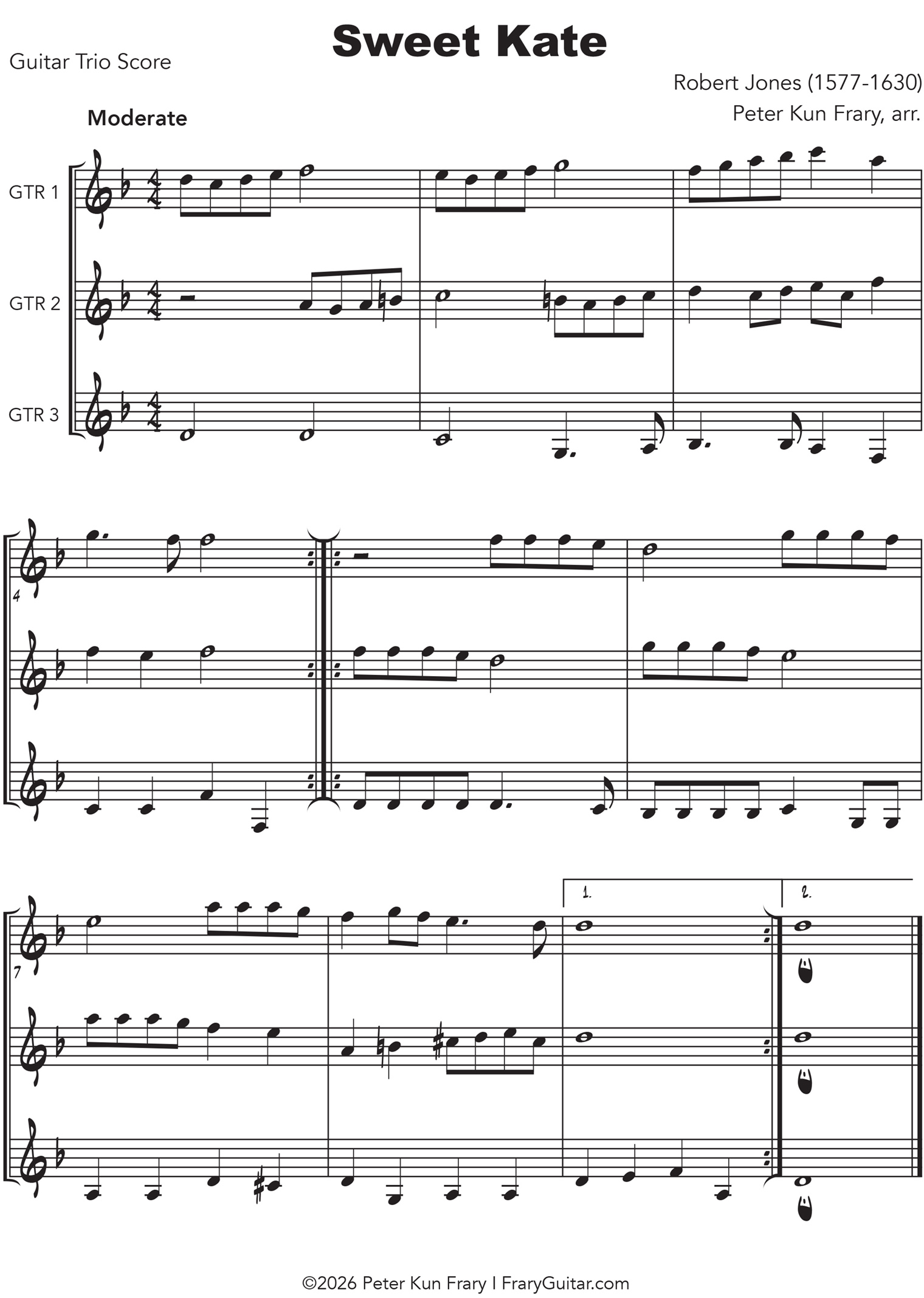
Jones wrote “Sweet Kate,” also known as “Think’st thou Kate,” and published it in his 1609 song collection, A Musical Dreame. The lyrics depict a witty and playful dialogue between two potential lovers. The lusty poetry of early 17th-century English song composers is evident in the direct and often humorous lyrics of songs about romance:
Sweet Kate of late ran away and left me plaining:
"Te-he-he" quoth she, "gladly would I see any man to die with loving!"
"Abide!" I cried, "or I die with thy disdaining"
"Never any yet died of such a fit; neither have I fear of proving!"
Unkind! I find thy delight is in tormenting:
"Abide!" I cried, "or I die with thy consenting"
"Te-he-he" quoth she, "make no fool of me!
Men I know have oath at pleasure;
But their hopes attain'd, they bewray they feign'd
And their oaths are kept at leisure"
Her words, like swords, cut my sorry heart in sunder:
Het flouts with doubts kept my heart's affections under
"Te-he-he" quoth she, "what a fool is he stands in awe of once denying!"
Cause I had enough to become more rough: so I did. O happy trying!
Popular songs during that era were often published in various forms, such as voice and lute (lute song), part-song (with multiple singers), instrumental ensemble (consort), and lute solo. Why so many published versions of the same piece? Renaissance secular music was primarily intended for home entertainment. Since broadcast and recorded audio were not yet invented, people consumed music by buying the scores and playing it themselves at home. Part-songs and ensembles were performed at parties, while solo lute and lute songs provided solitary and family entertainment. My trio arrangement of “Sweet Kate” is based on the part-song version.
The guitar 1 part of Minuet in G Major uses notes in the fifth position. If you're unfamiliar with the fifth position, review the New Notes section earlier in this unit.
The witty and playful dialogue between the two lovers is depicted by the echoing back and forth between guitar 1 and guitar 2. Guitar 3, normally a supporting bassline, joins the dialogue for a couple of measures in the second half.
Aim for a mildly peppy tempo of 116 to 120 BPM (allegro).



 Sweet Kate Musings
 Study Tips
 Listen to the Track