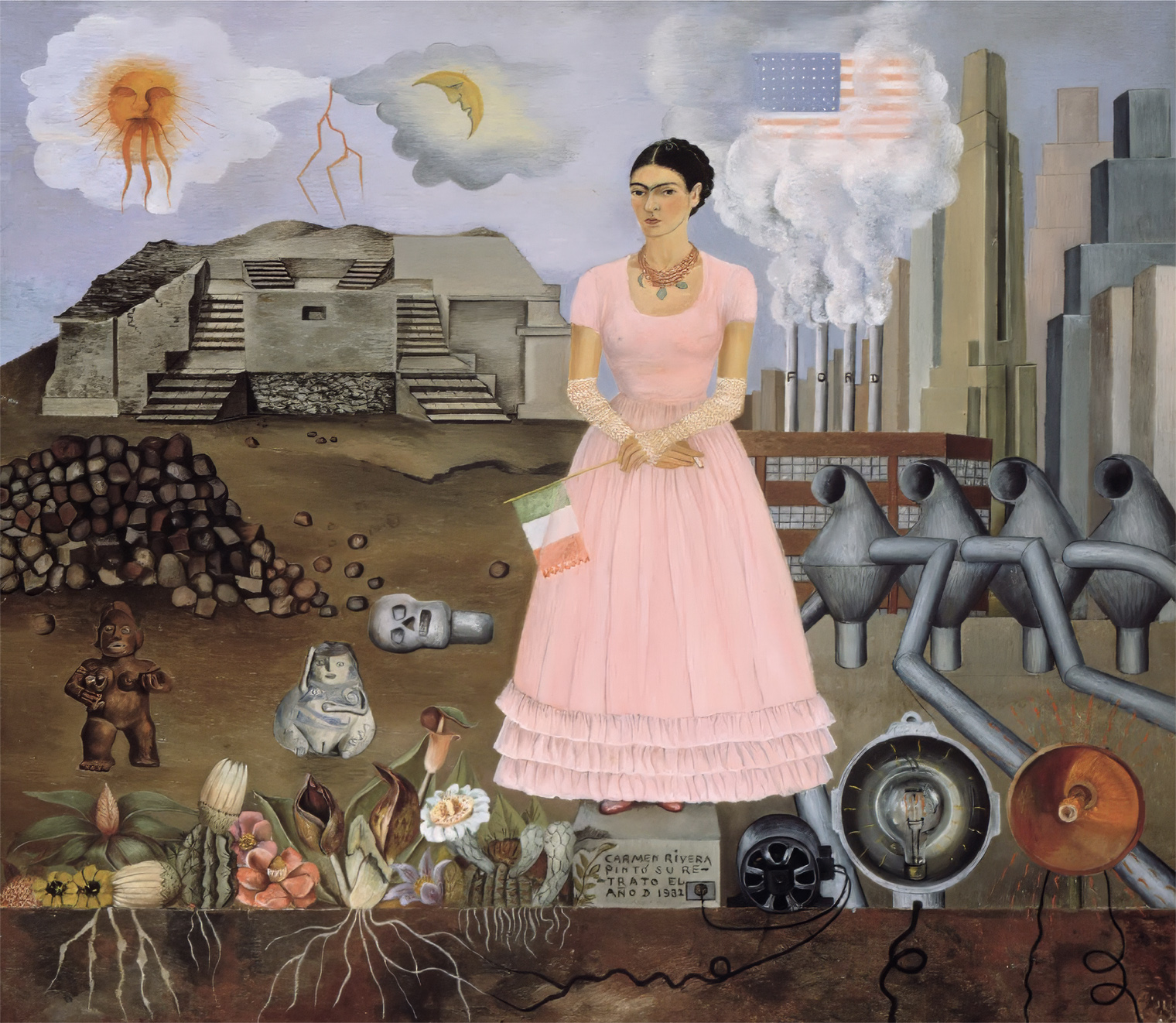
Postcolonial México’s history is marked by a struggle for nationhood despite a collision of diverse races, religions, languages, and cultures. Unlike European nationalism, which arose from common language and culture, Mexican nationalism emerged from the need to unite diverse cultural groups against foreign domination. Thus, the nation of México was a reaction against centuries of colonialism and bore its long and painful emergence through the Independence of 1810, Reform of 1857, and Revolution of 1910.
Frida Kahlo 1932 | Self-portrait on the borderline between México and the United States | Detroit Institute of Arts
The 1910 Revolution paved the way for artists like Diego Rivera, José Clemente Orozco, and David Alfaro Siqueiros to reject colonial influences and forge a Mexican identity based on pre-conquest Aztec culture. This Aztec Renaissance was echoed in music by Carlos Chávez and others. However, after centuries of colonialism, only a remnant of Aztec culture remained in the main population. The face of México was the mestizo, a person of mixed indigenous and Spanish descent. Mestizo culture, including its music, was a cross-cultural blend of Spanish and native elements, growing to become uniquely Mexican.
Composer Manuel María Ponce (1882-1948) came of age during the 1910 Revolution and pioneered the use of mestizo music as a foundation for Mexican nationalism.
Studies at Home and Aboard
Born Manuel María Ponce Cuéllar in Fresnillo, Zacatecas, México, in 1882, he was one of twelve children. At four, he began piano and solfège studies with his older sister, Josefina. Ponce’s early interest in composition led him to write La Marcha del Sarampion (March of the Measles) at nine after contracting the disease.
Conservatorio Nacional
Ponce began formal studies at the Conservatorio Nacional in México City in 1901. In 1904, he sold his grand piano and left México to study with Luigi Torchi and Dall’Olio at the Liceo Rossini in Bologna, Italy. During this time, Ponce worked on a trio for piano, violin, and viola, and completed his Piano Sonata No. 1.
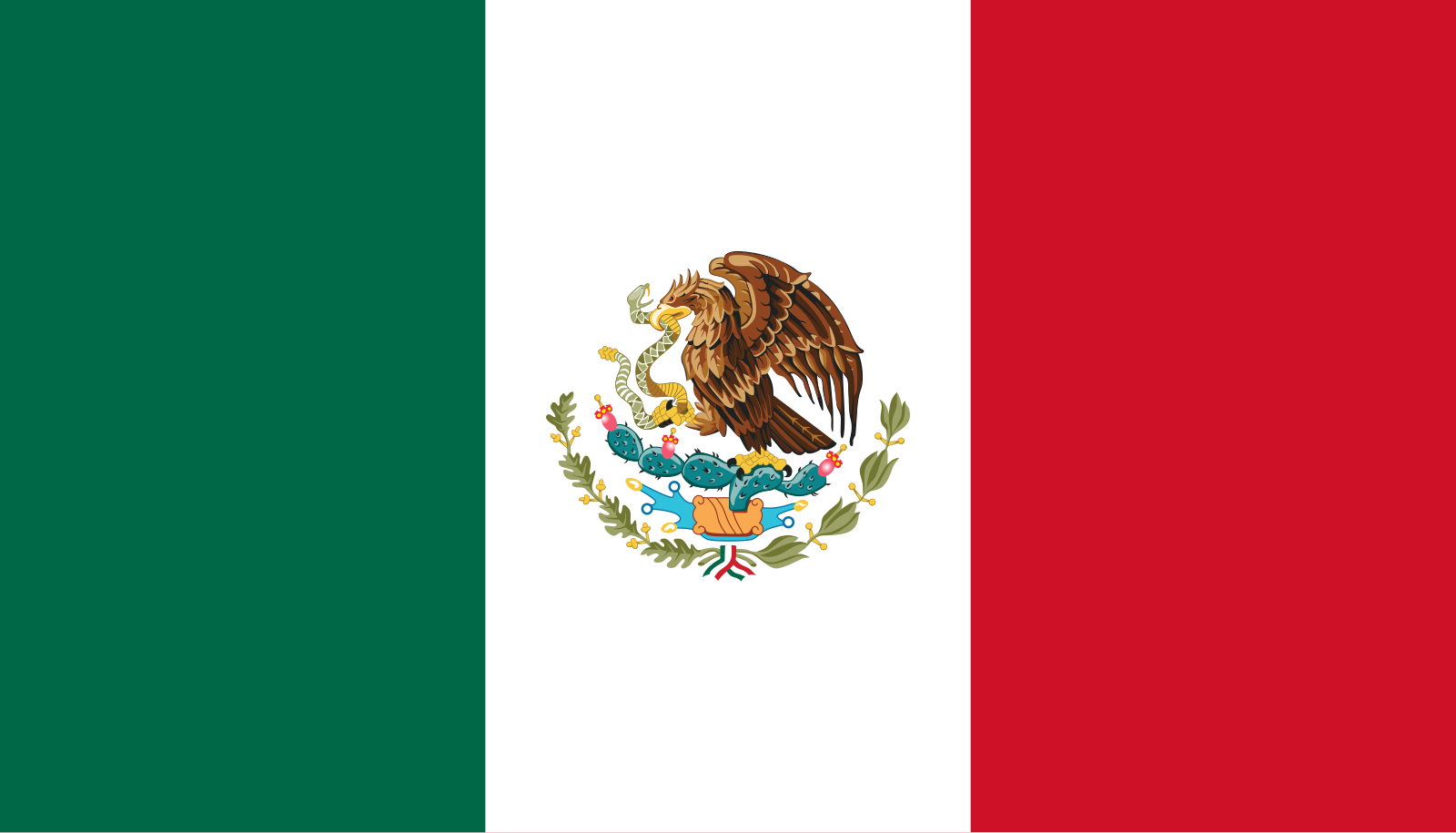
México | México (green) is located in Central America and adjacent to the United States. The American Invasion of 1848 cut México in half: México's former northern territory is now part of the United States. | Wikimedia Commons
Germany
In 1906, Ponce transferred to the Stern Conservatory in Berlin to study piano with Martin Krause. During his time in Germany, Ponce researched German musical folklore and was encouraged to explore the indigenous music of México:
. . . his German friends who delighted in German folk-song insisted he waste no further time in bringing to light the folk-music treasures of México, urging him not to exclusively devote himself to the European Classics (Robert Stevenson, Music in Mexico, New York: Crowell, 1952, p. 235.)
Ponce's work in musical folklore initiated and profoundly influenced musical nationalism and ethnomusicological research in México during the Revolution of 1910 and the decades which followed.
France
Ponce returned to Europe in 1925 to study composition with Paul Dukas at the École Normal de Musique, planning to update his compositional style.
Musical Style
Although the eclecticism of his voluminous musical output has baffled many, Ponce's transformation from Romantic salon pieces to extensive nationalistic and neoclassic works has followed a consistent pattern of growth. Kaphan observed that ". . . the dramatic change in Ponce's compositional style between 1912 and 1940 paralleled the overall change in style of Mexican music composition between those dates" (Kaphan, Change in Cultural Context and Musical Style, Ph.D. dissertation, University of California at Los Angeles, 1977, p. 176). Stevenson credits the stylistic variety of Ponce to his willingness to try new things:
He had a unique ability to speak directly to the masses, and yet also to speak, when he so desired, in a sophisticated idiom appealing to the most advanced mind. Accused by Bossi in 1905 of writing in an 1830 style, Ponce in the 1930s was an avant-garde. He was able to change with the times. His conversion to newer ways of thinking was, moreover, sincerely felt, and unlike others whose modernisms were an unconvincing veneer, he spoke as urgently in his later style as in his earlier (Robert Stevenson, Music in Mexico, New York: Crowell, 1952, p. 235).
Indeed, the years of studying and composing in Paris resulted in a metamorphosis of his writing style from neo-romanticism to the modernism of the 1930s and 1940s.
Contributions
The international reputation of Manuel María Ponce, outside of his beloved folkloric song, “Estrellita,” rests solely on his formidable contribution to the guitar repertoire. Spaniard Andrés Segovia (1893-1987), Ponce's leading interpreter, comments on Ponce's position in the twentieth-century revival of the classical guitar:
He lifted the guitar from the low artistic state in which it had lain. Along with Turina, Falla, Manen, Castelnuovo, Tansman, Villa-Lobos, Torroba, etc., but with a more abundant yield than all of them put together, he undertook the crusade full of eagerness to liberate the beautiful prisoner. Thanks to him—and to the others I have named—the guitar was saved from the music written exclusively by guitarists (Andrés Segovia, "Manuel M. Ponce: Sketches from Heart and Memory," Guitar Review, no. 7, 1948, p. 4).
However, within his native country of México, Ponce was a preeminent figure in the music of the early twentieth-century: he initiated musical nationalism during the early years of the Revolution of 1910; he pioneered the scholarly study of Mexican musical folklore; and his works in the larger forms set a precedent for Mexican composers beyond the status quo of salon music.
Although this article spotlights Ponce's guitar music, it should be noted that his voluminous output also includes numerous solo songs, choral pieces, piano solos, chamber music, and orchestral works.
Ponce's guitar works form a core part of the instrument's repertory, the best-known works being his Variations and Fugue on 'La Folia' (1929) and Sonatina meridional (1932). Today we sample the first movement of Sonatina meridional (Southern Sonatina).
Ponce’s guitar sonatinas, Homenaje a Tárrega and Sonatina meridional, though shorter and simpler to play than his sonatas, possess significant technical difficulty and artistic merit and employ full sonata form. Unlike piano sonatinas designed for pedagogical purposes, these pieces are called sonatinas primarily due to their shorter length and accessibility to advanced students rather than professionals only. Consequently, Ponce’s guitar sonatinas can be considered a less pretentious type of sonata, possibly influenced by Ravel and Busoni’s piano sonatinas.
Cross-Cultural Influences
This work, written while Ponce was living in Paris in 1932 (published in 1939), is the last guitar solo Ponce wrote for Segovia and is an example of the cross-fertilization of musical styles—folkloric, neoclassical, neo-romantic, and impressionistic—which characterize Ponce's music of the late 1920s and early 1930s. The predominance of Spanish folkloric elements and the status of sonatina in this work are both due to Segovia's prodding.
. . . why don't you write a Sonatina—not a Sonata—of purely Spanish character? It could be offered to Schott, to go in the series of medium difficulty. Make your mind up. Here you have themes enough, although in reality you don't even need them (Corazón Otero, Manuel M. Ponce and the Guitar, London: Musical New Services, 1983, p.
57.)
Spanish influenced elements are also evident in the titles of the three movements: Campo (country), Copla (popular Spanish song) and Fiesta (festival or party).
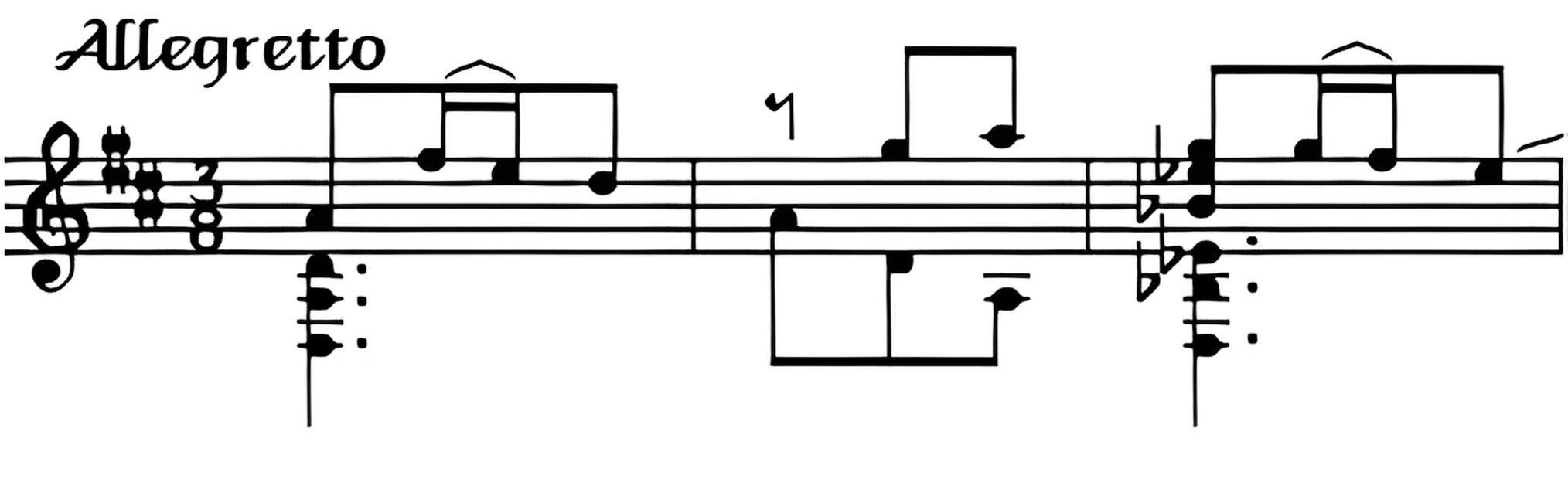
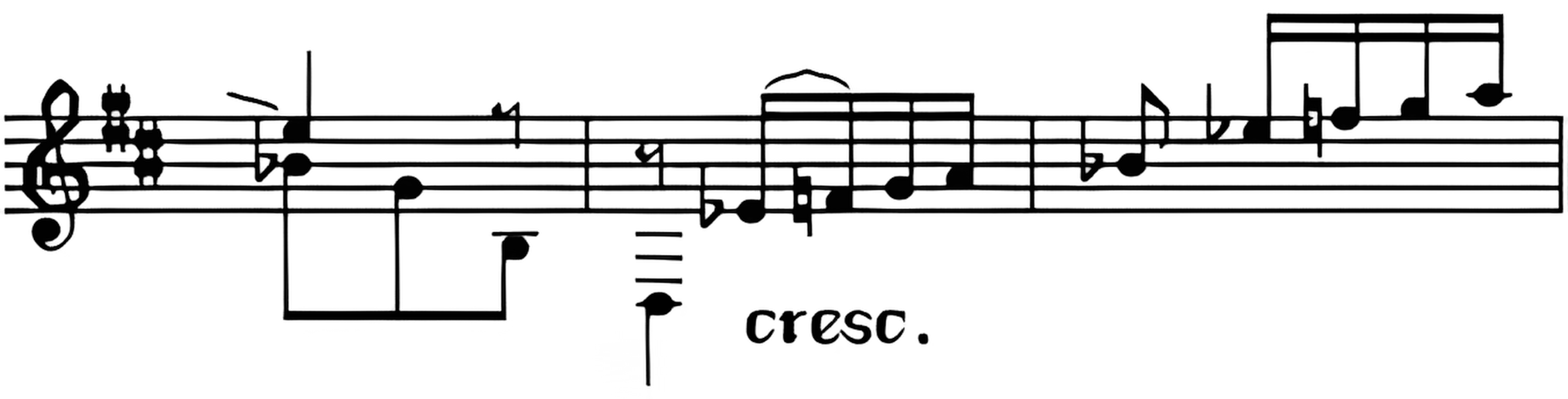
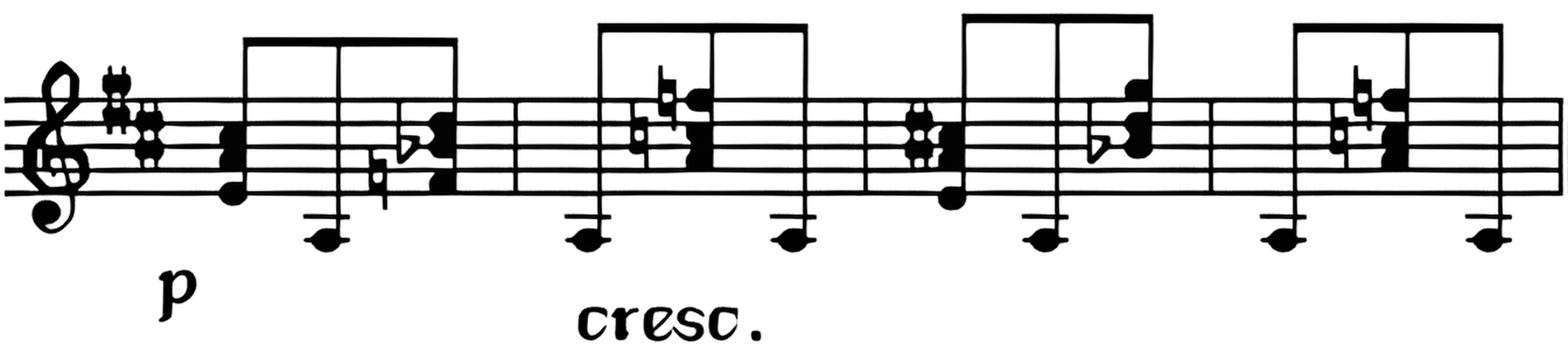
The first movement, Campo, marked Allegretto and in D major and 3/8 meter, is in sonata form. The first theme, evocative of Andalusian flamenco, begins with the chord progression of I flat-II and features the Phrygian mode, a mode typical of flamenco:
Sonatina meridional | Campo, page 3, measures 1-6 (Manuel María Ponce, Sonatina meridional. Mainz: Schott, 1939), Peter Frary, guitar
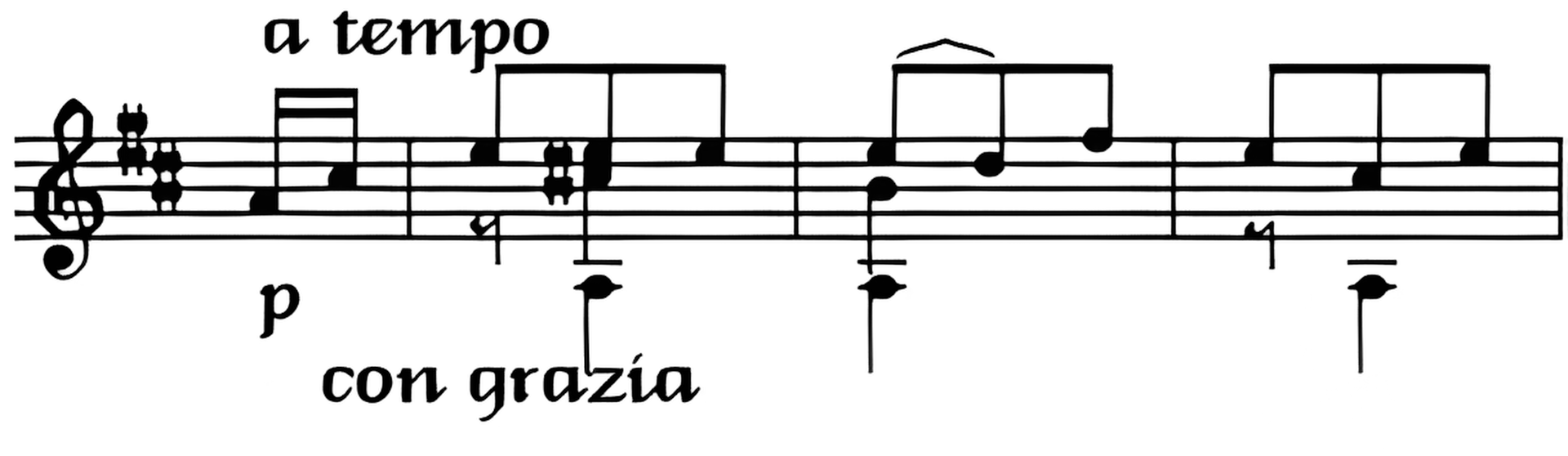
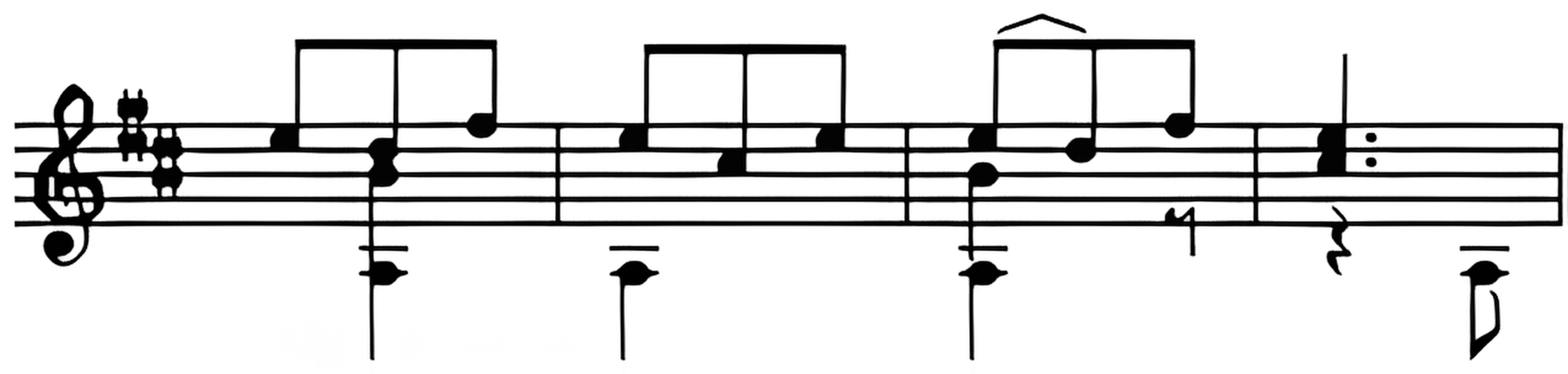
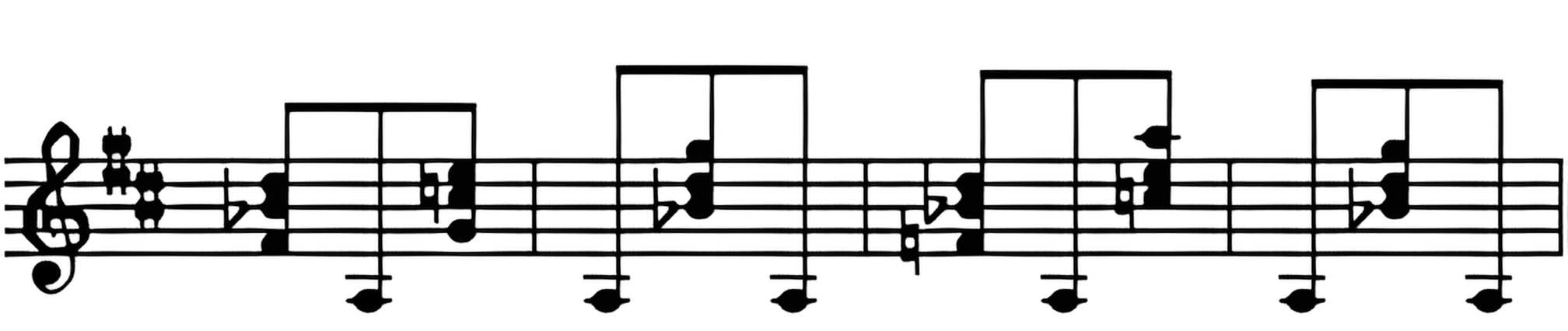
A lyrical second theme is announced in the dominant key using a low A note pedal tone immediately after a transitional passage of bass notes utilizing muted strings (étouffé or palm mutes):
Motives from the first theme close the exposition; the exposition is repeated. The development section features motivic manipulation of both themes. After a series of passing modulations, the development settles down in the dominant key and climaxes with an extended series of chords in A Phrygian mode over an A note pedal tone beginning at measure 126.
At measure 142 a full recapitulation—return to the first themes and home key—commences.
Now that you have identified the structural elements, audition the first movement, Campo. Listen carefully for the cross-cultural influences of Spanish flamenco, Mexican folk music, French Impressionistic harmony, and the sonata-form structure.
Ponce's Sonatina Meridional | Valeria Galimova, guitar (9:53). Listen to the first movement, Campo (0:00 to 4:35).
Vocabulary
Aztec Renaissance, mestizo, Manuel María Ponce, sonatina


 Studies at Home and Aboard
 México
.svg.png "México | México (green) is located in Central America and adjacent to the United States | Wikimedia Commons")
 Musical Style
 Contributions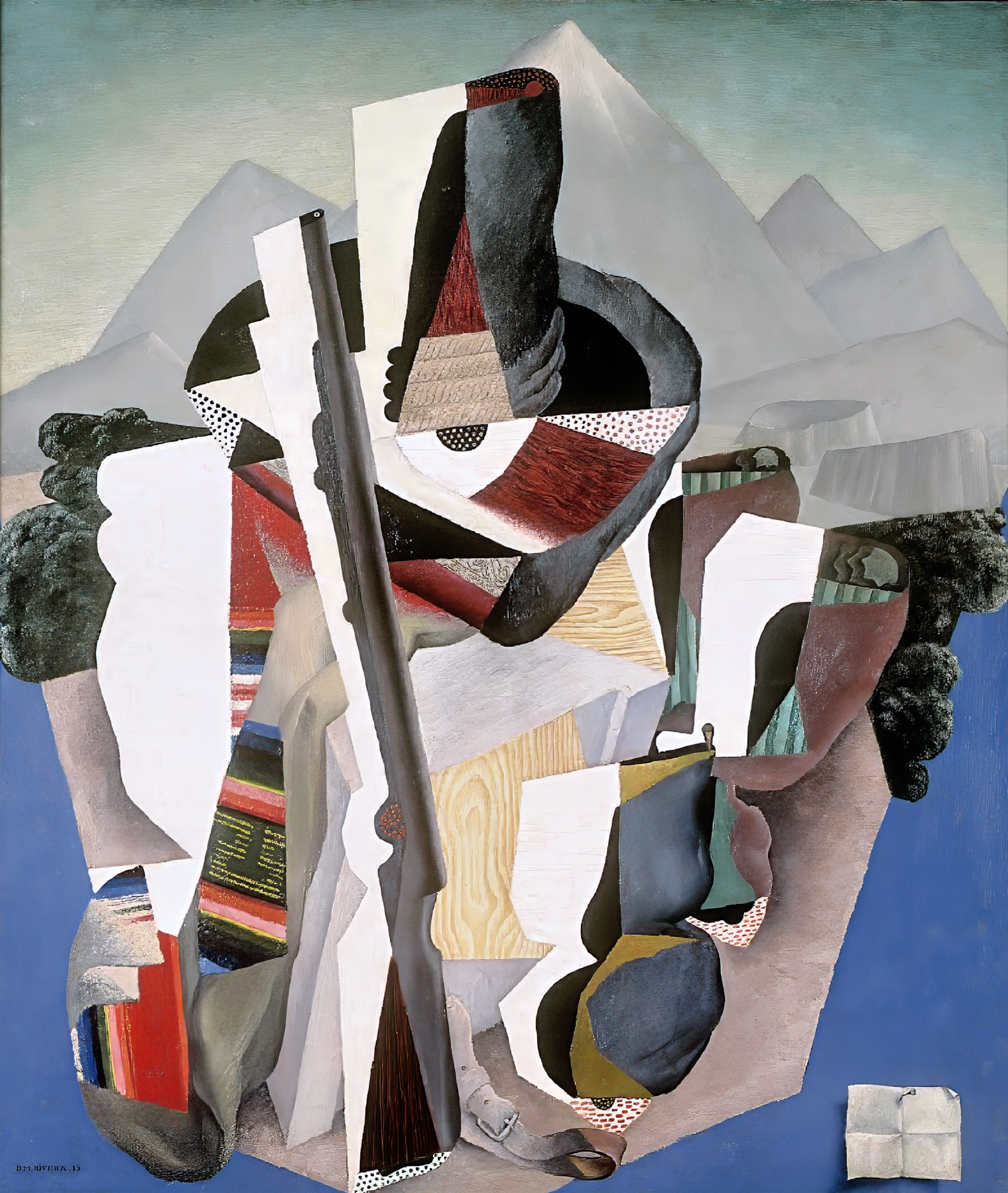
 Sonatina meridional
 Cross-Cultural Influences