.•
Canon EF 35 2.0 IS USM
Review of a Classic Prime Lens
Peter
Kun Frary
.
The EF 35 2.0 IS USM, released in Fall 2012, is a redesign of the 1990 EF 35 2.0. I loved the perspective and portability of the original, but it was overdue for an update, especially the autofocus, so I threw my credit card at the new model like a hungry dog. Now, ten years hence, I revisit this lens after buying a mint one in a pawnshop.
Hawaii Theatre | EOS Rebel SL1, EF 35 2.0 IS USM

This review consists of my opinions and observations as a hobbyist. No scientific measurements, MFT charts or pixel peeking comparisons will be found here.
 Why a 35mm Lens? Why a 35mm Lens?
For me, the semi-wide perspective—63 degrees—of the EF 35 2.0 IS USM is natural and intuitive to use on a full-frame camera such as the 5D MK IV. The field of view matches how I see the world and is ideal for off-the-hip and point-and-shoot moments. I also like it for landscapes: not too wide but wide enough to take in a sweeping view of a vista. Wider lenses tend to take in too much and are more challenging to compose with. Finally, the semi-wide coverage of 35mm is ideal for showing a subject in its environment, e.g., an artist at the easel or a ceramicist working with clay.
If you shoot APS-C, e.g., EOS Rebel, 80D, 90D, etc., coverage is similar to a normal lens on full-frame camera, i.e., a 56mm equivalent coverage.
EF 35 2.0 IS USM | Image courtesy Canon

Compared to most zooms, the EF 35 2.0 IS USM is small and inconspicuous, making it ideal for street photographers, low-key social gatherings, and as a backup lens for travel.
 Compatibility Compatibility
The EF 35 2.0 IS USM lens is compatible with Canon EOS SLR and DSLR cameras, both full frame and APS-C (1.6X). With a mount adapter, it may be used on EOS R and M series mirrorless cameras. I've been using my EF 35 2.0 IS USM on an EOS R and R6 MK II, and it works flawlessly with the adapter. For R series shooters, the EF 35 2.0 IS USM is a great alternative to the RF 35 1.8 Macro IS STM if you don't need .5X macro and are okay with an adapter.
The EF 35 2.0 IS USM does not fit FD mounts and non-Canon cameras such as Pentax, Nikon, Fuji, etc.
Ala Moana Window | EOS 5D MK IV, EF 35 2.0 IS USM, F3.2, 1/40, ISO 100

 Construction Construction
The EF 35 2.0 IS USM is larger and heavier than the old EF 35 2.0—335g vs 210g—but still petite and lightweight. Styling is clean and modern—dare I say handsome?
EF 35 2.0 IS USM | Image courtesy Canon
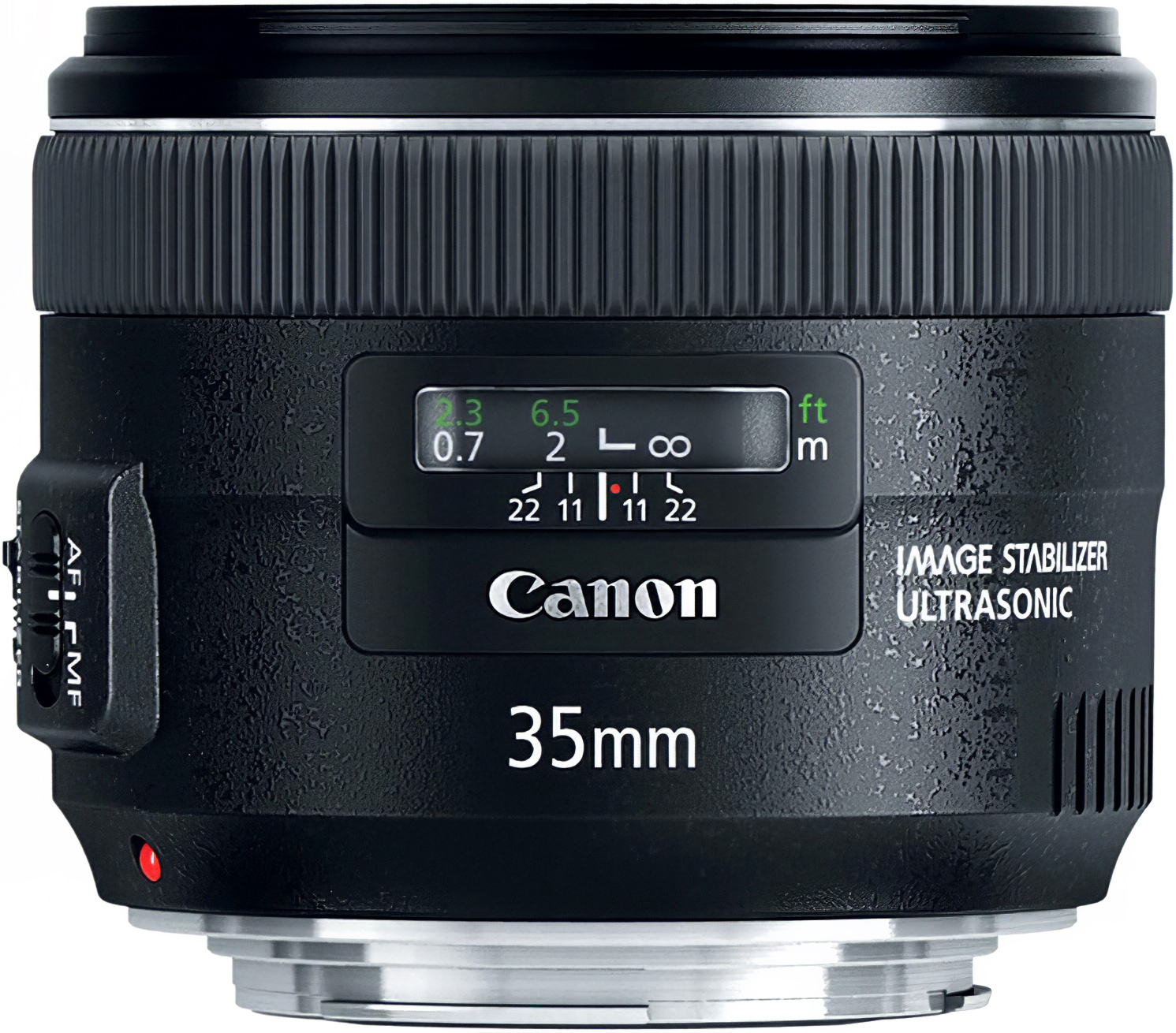
Barrel plastics, switches, and the manual focus ring feel sturdy and operate smoothly. Finish work is excellent, and the textured matte finish is attractive and fingerprint-resistant. A basic DOF scale for hyperfocal focusing is adjacent to the distance scale, with markings only at F11 and 22. Filter threads are 67mm, a size shared by many Canon lenses. The EF mount flange is constructed of sturdy metal.
 Image Quality Image Quality
Wide open, the EF 35 2.0 IS USM delivers sharp edge-to-edge images with smooth bokeh and round defocused highlights. It becomes razor sharp by closing down another stop. It is significantly sharper along the periphery compared to the old EF 35 2.0 lens, making it a better choice for landscapes and other edge-critical usage.
Irish Pub Wall | EOS Rebel SL1, EF 35 2.0 IS USM, F8, 1/320, ISO 100 | This lens is good for architecture due to its well-corrected distortion.

Chromatic aberration (CA) is well corrected and, under most shooting conditions, is not noticeable. In extreme high-contrast situations such as tree branches against a bright sky, slight purple fringing may be visible if you pixel-peep. Indeed, chromatic aberration performance is significantly better than both the old EF 35 2.0 and the many fabled EF 35 f/1.4L USM of yesteryear.
Living in Hawaii, I can't help but shoot a blazing sunset here and there. And I've experienced no problems with flare or ghosting in sunset images, unlike most zooms.
 Coma Coma
Hallelujah, this lens is well corrected for coma, exhibiting only a minimal amount on the periphery. What is coma? It's a flare-like aberration where sharp points of light—stars or distant street lights—are rendered as small wings or comet tails.
LED Lights | EOS 6D and EF 35 2.0 IS USM | F2.2, 1/60 sec., ISO 100. At or near wide open, coma may be seen on points of light near the periphery.

While coma is not apparent in daytime images, city nightscapes and astronomy images may reveal mild coma on bright points of light in the periphery at F2.0 and F2.5 (see right lower corner of the above image). The center and mid-sections of the frame render normally. Stop down to F2.8 or more, and coma is gone for all practical purposes.
For most of my nightscape work, the corners are not important (usually murky and dark), so I wouldn't hesitate to shoot wide open at F2.0 when needed. If there's points of bright on the periphery, I'll stop down to F2.8.
If you're shooting wide open portraits against city lights, coma is not an issue as the points of light are defocused and appear as round bokeh balls.
Night Portrait | EOS 5D MK II, EF 35 2.0 IS USM and bounced 430EX II | F2.0, 1/8 sec., ISO 1250. IS steadied the 1/8-sec. shutter speed well.

 Light Falloff Light Falloff
Like all fast primes, this lens exhibits light falloff when shot wide open. Stop down to f/2.8, and light falloff is significantly reduced. Imaging processing software such as Lightroom or DPP4 can automatically remove or reduce falloff if desired. Save for sky and white wall pics, I prefer a little natural vignette on my images and often disable the lens profile correction in Lightroom for a more “natural” look. The lens profile was disabled in the image above.
 Focus Focus
Focus is achieved internally, and thus, the front element doesn't rotate or move during AF operation. The ring-type USM delivered surefooted and fast AF on my 6D, 6D MK II and 5D MK IV, rarely missing its target, unlike the prior EF 35 2.0 model. I also own the RF 35 1.8 Macro IS STM, and while the RF version is on par optically with the EF 35 2.0 IS USM, AF speed and reliability, especially AI servo, are slower and less surefooted compared to the EF design.
 Quasi-Macro Quasi-Macro
Although not a macro lens, the .24X magnification at closest focus (9.45” or 0.24m) is good enough for flat art, small products, and medium-sized flowers.
Koi Joy | EOS SL1 and EF 35 2.0 IS USM | F5.6, 1/125 sec., ISO 160.

Manual Focus
Video buffs will like the manual focus: silky and precise, no slop, and a long throw for smooth transitions. And because it is mechanically linked, manually focusing without half-pressing the shutter button is possible. Indeed, there is also no need to flip a switch to engage manual focus: simply grab the narrow but well-ribbed MF ring and turn.
After years of use, the rubberized coating on the manual focus ring became sticky. I was able to clean it off with a few treatments with a Q-tip and lighter fluid. Once the rubberized paint was removed, the underlying black plastic ring looked fine and worked perfectly.
Honolulu Vista | EOS 5D MK IV, EF 35 2.0 IS USM | F10, ISO 100, 1/400 sec. | The coverage of a 35mm lens is ideal for landscapes.

 Video Focus Video Focus
Movie servo focus with ring-USM lenses on older EOS cameras like the 60D and SL1 is too fast, resulting in abrupt transitions and jerky stops. Manual focus or AF pre-focus are the best choices for video with older cameras. However, movie servo on the 80D, 90D, 5D MK IV, and R series is surprisingly smooth with this lens. Although focus is silent to most human ears, built-in camera mics may record pianissimo focusing noises—movement of internal elements—so use an external mic or outboard audio with this lens.
Honolulu Hale | EOS 6D, EF 35 2.0 IS USM | F2.5, ISO 250, 1/40 sec.

 Image Stabilization Image Stabilization
The inclusion of image stabilization (IS) is a welcome feature, providing 4 stops of slower hand-holdable shutter speeds. Canon's claim of 4-stops usually didn't work for me—3 stops is practical—but a non-coffee drinker might squeeze out that fourth stop. Nevertheless, with F2.0 and IS, I can hand-hold my camera and nail sharp images of evening street scenes, dim bars, and stages down to about 1/8 sec. Others claim 1/4 sec., but I can only get away with such speeds if I brace against a solid object.
Old Honolulu Police Station | EOS 5D MK II, EF 35 2.0 IS USM

 Lens Hood Lens Hood
A hood also helps protect the front element from dust, fingerprints, doggie noses, rain, and flare. Canon knows hobbyist shooters are suckers for OEM accessories and puts the screws to you for the EW-72 hood with a $50 price tag.
EW-72 | Dedicated hood for the EF 35 2.0 IS USM (image courtesy Canon)

What does 50 greenbacks buy you? A well-made plastic hood with matte paint matched to the lens finish, rayon flocking to nix reflections, an easy squeeze tab release, a Canon logo, and "Made in Japan" inscription. The lightly textured matte finish, unlike most Canon hood finishes, is fingerprint-resistant!
This bayonet design is different from most other bayonet hoods. Rather than a tight groove, this hood fits loosely while being twisted on. It only locks tight at the optimal position (cutouts horizontal). To remove the hood, press the release tab while twisting.
Washington Place | Honolulu | EOS 6D, EF 35 2.0 IS USM | Hand held low light images are possible with F2.0 and 4 stops of image stabilization.

If you search Ebay and Amazon, you can find less expensive knockoff EW-72 hoods made by JJC, Rainbow Imaging and others.
 Last
Blurb Last
Blurb
The EF 35 2.0 IS USM is a significant redesign of the old EF 35 2.0, boasting fast and accurate AF, improved build, 4-stop stabilization, excellent control of coma and distortion, and vivid and sharp images across the frame. Canon got just about everything right with this redesign! And, I must add, it stands up well to its RF replacement, the RF 35 1.8 Macro IS STM, with equivalent sharpness and optical corrections but with faster, quieter, and more reliable AF.
I found the EF 35mm 2.0 IS USM nimble and comfortable to shoot with on my full-frame EOS 5D MK IV, 6D, and 6D MK II cameras. The F2.0 aperture made for a bright optical viewfinder, and the lens felt lightweight but well-balanced on my cameras. On a R6 MK II and R7, it was a little more bulky because of the adapter, but still felt comfortable in hand.
With the R series mirrorless system now the main priority for Canon, production of the EF 35 2.0 IS USM ceased in 2021. However, refurbished, old stock, and used samples are readily available. Demand for this optic has kept prices on the high side, baring witnessness to the high quality and performance of this design.
Finally, please help support this website by purchasing this lens at Amazon.
 
10/03/2013 | Revised 10/10/2026
 Features and Specs Features and Specs
- Focal Length: 35mm
- Aperture: F2.0 to
22
- Elements:
10 elements in 8 groups with 1 GMo aspherical element
- Lens coating: Super Spectra
- Lens Format Coverage: full-frame
- Lens Mount: EF
- Auto Focus motor: ring-USM
- Min. Focusing Distance: 9.45” / 0.24m
- Maximum Magnification: .24X
- Angle of View (Diagonal): 63°
- No. of Diaphragm Blades: 8
- Filter Size: 67mm
- Image Stabilization: 4-stops
- Included Accessories: lens caps
- Made in Japan

- Weight:11.8oz / 335g
- Diameter and
Length: 3.1 x 2.5 inches / 77.9 x 62.6mm

- $599 (new)
- $300 to 600 on the used market
Old Honolulu Police Station | EOS Rebel SL1, EF 35 2.0 IS USM

More Images taken
with the EF 35 2.0 IS USM (click to
enlarge)

©Copyright 2013-27 by Peter Kun Frary | All Rights Reserved
|
 •••••••
 •••••••
 •••••••
 •••••••
 •••••••